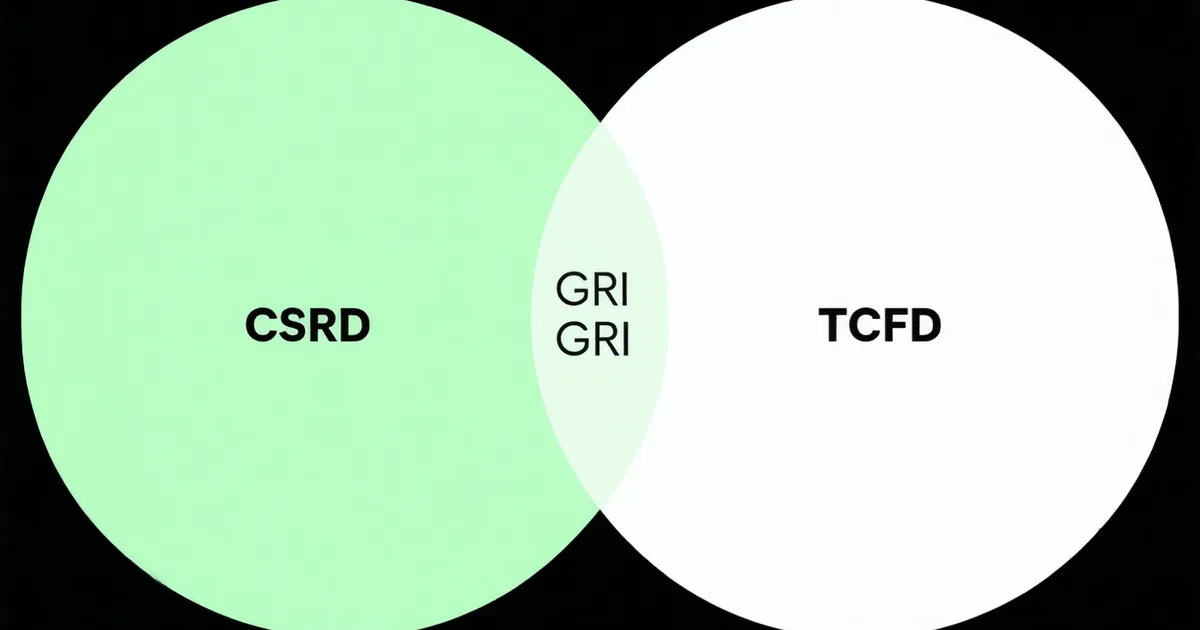
A sustainability director at a mid-size Ohio manufacturer once described her framework situation this way: "Our European customer says we need CSRD-aligned data. Our institutional investor sent a TCFD questionnaire. Our compliance team heard GRI is what everyone uses. And I have one analyst and a deadline in April."
This is not an unusual position. The proliferation of ESG reporting frameworks creates genuine confusion about what's mandatory versus voluntary, what overlaps, and where to spend limited time. This post maps out the three frameworks most relevant to mid-market manufacturers, explains their relationships, and gives you a decision logic for prioritizing.
The fundamental distinction: mandatory vs. voluntary
Start here: CSRD is a legal obligation with enforcement consequences. GRI and TCFD are voluntary frameworks. If CSRD applies to your company, it takes priority over everything else — not because it's better designed (though ESRS E1 is actually quite rigorous), but because non-compliance carries regulatory and audit liability.
CSRD applies to:
- EU-listed companies and large non-listed EU companies already covered under NFRD, reporting from fiscal year 2024
- Large EU companies not previously covered (balance sheet > €20M, turnover > €40M, or >250 employees), reporting from fiscal year 2025
- Listed SMEs in the EU, with a reporting start date being phased with opt-outs available
- Non-EU companies with significant EU operations (>€150M net turnover in the EU and at least one large EU subsidiary or branch), reporting from fiscal year 2028
For a US mid-market manufacturer, CSRD likely becomes relevant when a major European customer or investor requires it, or when you expand EU operations past the thresholds. If you're in neither situation today, you're probably in voluntary territory — which is where GRI and TCFD live.
GRI: the comprehensive ESG baseline
The Global Reporting Initiative standards are the most widely used sustainability reporting framework globally. GRI 305 specifically covers emissions disclosures, requiring Scope 1, 2, and 3 reporting with methodology notes.
GRI's approach is modular: you report on Universal Standards (GRI 1, 2, 3) applicable to all organizations, then select Topic Standards based on your materiality assessment. For a manufacturer, GRI 305 (Emissions), GRI 302 (Energy), and GRI 306 (Waste) are typically the core environmental standards.
GRI's main value is that it creates a common language across industries. If you're a supplier responding to customer sustainability questionnaires, citing GRI 305 alignment tells procurement teams at large companies exactly what data you're disclosing and in what format. That has practical value for supply chain relationships.
GRI 305 and CSRD's ESRS E1 overlap significantly on the quantitative disclosures — both require Scope 1, 2, and 3 GHG data with methodology notes, both require dual Scope 2 reporting (market-based and location-based). If you're building toward CSRD compliance, much of that data collection satisfies GRI 305 simultaneously. We'd frame GRI as a reporting template rather than an additional data collection burden if you've already structured your emissions accounting for CSRD.
TCFD: climate risk through the investor lens
The Task Force on Climate-related Financial Disclosures, established by the Financial Stability Board, produces recommendations for how companies should disclose climate-related risks and opportunities to investors. TCFD's four pillars — Governance, Strategy, Risk Management, and Metrics & Targets — are structured around financial materiality rather than environmental completeness.
The critical distinction between TCFD and the other two frameworks: TCFD is primarily interested in how climate risk affects your business, not just how your business affects the climate. Physical risk (flooding, heat stress, supply chain disruption from climate events) and transition risk (carbon pricing, changing customer demand, stranded assets) are the analytical core of TCFD reporting.
TCFD's Metrics & Targets pillar does require GHG emissions disclosure, which is where it intersects with your Scope 1-3 data. But the emissions data in TCFD serves a different narrative: it's evidence for your transition risk exposure and target-setting credibility, not a standalone environmental disclosure.
TCFD has been incorporated by reference into multiple mandatory frameworks. The UK made TCFD-aligned disclosure mandatory for large UK-registered companies and listed entities from 2022. ESRS E1 and E2 have substantial structural overlap with TCFD. The SEC's climate disclosure rule, even in its revised form, draws from TCFD architecture. Understanding TCFD helps you understand the investor-facing logic behind climate disclosure requirements generally.
How the three frameworks relate in practice
Here's a useful mental model: GRI 305 is what you disclose. TCFD is the context and risk framing for why it matters financially. CSRD/ESRS E1 is the mandatory EU legal structure that incorporates both.
ESRS E1 was developed with explicit reference to both GRI 305 and TCFD. EFRAG (the European Financial Reporting Advisory Group) that drafted the ESRS standards incorporated significant GRI content and TCFD structure intentionally. ESRS E1 requires disclosures that would satisfy a substantial portion of GRI 305 and TCFD Metrics & Targets simultaneously.
Practically: if you build your GHG inventory to ESRS E1 standards, you're producing data that satisfies GRI 305. If you add a climate risk analysis using TCFD's physical and transition risk framework, you're producing the strategic context that ESRS E2 and investor TCFD requests require. These aren't three separate workstreams — they're one data and narrative program reported in three slightly different formats.
The scenario where you only need GRI or TCFD
If you're a US-based manufacturer with no EU subsidiaries, no significant EU revenue, and no current investor mandate for CSRD-aligned disclosure, your near-term obligation is probably voluntary. In that case:
- If your primary driver is customer supply chain requests, GRI 305 is the standard language they're using — build toward that
- If your primary driver is institutional investor questionnaires (ESG-oriented funds, lenders doing climate due diligence), TCFD alignment is what they're asking for
- If both apply, the overlapping data requirements mean doing the GHG inventory once, then producing two slightly different disclosure documents
We're not saying you should wait for a legal mandate before disclosing. There are real business reasons to disclose voluntarily — customer retention, access to green financing, competitive differentiation in procurement. The point is that voluntary reporting should be scoped to what actually matters to your stakeholders, not to checking every box on all three frameworks simultaneously.
What ESRS E1 actually requires on GHG emissions
Since CSRD is the mandatory driver for EU-connected companies, it's worth being specific about what ESRS E1 requires on the GHG front:
- Gross Scope 1, 2 (location-based and market-based), and Scope 3 emissions in tCO2e
- Scope 3 broken down by GHG Protocol category (all 15 categories, with disclosure of which are included and which are excluded with reasoning)
- Biogenic emissions and removals tracked separately from fossil-derived emissions
- Description of methodologies, emission factors, GWP values used (with reference to IPCC assessment report version)
- Organizational boundary (operational control, financial control, or equity share approach — with rationale)
- Base year emissions and any restatements
- Decarbonization targets and progress metrics
That's a substantial data and documentation requirement. Building a GHG inventory that satisfies these items requires the same source-linked, audit-trail-documented approach we've written about in other posts — not a high-level estimate, but a calculation that an assurance provider can trace to source documents.
The practical sequencing question
If you're facing multiple framework pressures simultaneously: start with your organizational boundary definition and your Scope 1 and 2 data collection. These are the foundation everything else builds on, and they're required identically across all three frameworks. Get those structured, documented, and defensible first.
Then layer in Scope 3 based on your materiality — Category 1 (purchased goods) and Category 11 (use of sold products) are often the largest for manufacturers, so they typically get tackled first. Once your emissions data is structured, the question of which framework to report into becomes largely a formatting and narrative exercise.
The frameworks diverge more significantly on qualitative content — governance statements, scenario analysis, target-setting methodology. That's where framework-specific work begins. But the quantitative emissions data is common to all three. Get that right first.