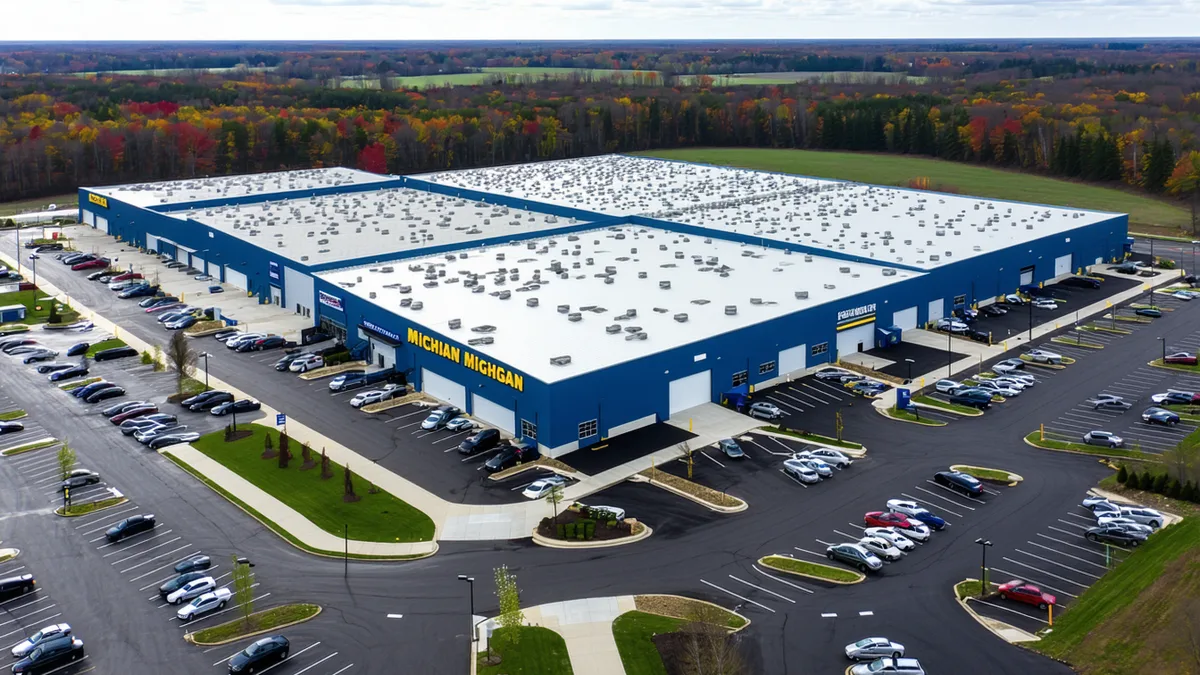
I hear a version of the same question from sustainability directors at US manufacturing companies every few months: "We're a Michigan-based manufacturer. Why should we care about CSRD?" The answer is almost always the same: because your largest customers might be European, or supply to European OEMs, and the Corporate Sustainability Reporting Directive creates upstream pressure that doesn't stop at the Atlantic Ocean.
This isn't abstract policy risk. It's supply chain mechanics. If your plant ships stampings or fabricated assemblies to a Tier-1 supplier that supplies a European OEM, and that OEM is subject to CSRD, your customer's sustainability report needs to account for Scope 3 emissions and material flows in their supply chain — including your facility's waste generation and recycled content data. That data request is going to land in your inbox.
What CSRD Actually Requires on Waste
The Corporate Sustainability Reporting Directive requires companies within its scope to report against the European Sustainability Reporting Standards (ESRS). For waste and material flows, the relevant standard is ESRS E5 — Resource Use and Circular Economy.
ESRS E5 disclosure requirements for waste include:
- E5-4: Resource inflows — including recycled and reused input materials, with documented sourcing
- E5-5: Resource outflows — waste generated by hazard classification and by disposal/recovery pathway; circular material rate
- E5-3: Policies and targets related to resource use and circular economy
ESRS E5-5 requires disclosure of total waste generated in metric tons, broken down by type (hazardous vs non-hazardous) and by treatment path (preparation for reuse, recycling, other recovery, incineration, landfill, and other disposal). This is structurally similar to GRI 306, which is deliberate — the ESRS frameworks were designed with significant interoperability with GRI standards. If you're already producing GRI 306 disclosures, the ESRS E5-5 mapping is mostly a translation exercise. If you're not producing GRI 306 disclosures, ESRS E5-5 requires building the documentation foundation from scratch.
The critical difference from US EPR frameworks: CSRD applies a materiality assessment approach — companies must assess which sustainability topics are material to their business and report on those with greater depth. Waste is generally material for manufacturing companies, which means ESRS E5 disclosures for manufacturers subject to CSRD will typically require the full disclosure package, not just summary figures.
Who Is Actually in CSRD Scope
CSRD has a phased implementation structure. Large EU companies (over 500 employees) were first in scope, with reporting beginning in fiscal year 2024. Mid-size EU companies entered scope in fiscal year 2025. Third-country companies (non-EU, which includes US manufacturers) with EU-generated net turnover above €150 million are brought into scope for fiscal year 2028 reporting.
But the scope question for US manufacturers is not just direct obligation — it's supply chain exposure. A US Tier-1 supplier that doesn't cross the €150M EU turnover threshold may not have a direct CSRD obligation. But their European customers do, and those customers need to disclose Scope 3 data including supplier material flows. The data request arrives via supply chain questionnaire, RFQ sustainability annex, or supplier qualification update — not from a European regulator. The consequence of not providing the data is commercial, not regulatory: risk to supplier qualification status.
We're not saying every US manufacturer will be subject to CSRD directly. We're saying that the CSRD data flow reaches into US supply chains well before 2028 through customer-driven sustainability data requests, and manufacturers who build the documentation infrastructure to respond to those requests are better positioned than those who treat CSRD as a foreign regulation that doesn't apply to them.
What Your European Customer Actually Needs From You
A European OEM or their Tier-1 supplier preparing a CSRD waste disclosure needs, at minimum, the following data from their US manufacturing suppliers:
Waste generation by type and treatment pathway. Total non-hazardous and hazardous waste generated at your facility, broken down by whether it was recycled, recovered, incinerated, or landfilled. This is essentially GRI 306-3 data — if you're producing GRI 306 disclosures, you can provide this relatively directly.
Recycled content in input materials. ESRS E5-4 asks about resource inflows including recycled content. If your European customer's product incorporates your stamped components, they need to know what percentage of the material in those components came from recycled sources. This requires documented recycled content certificates from your material suppliers — not estimates.
Circular material rate or equivalent metric. The circular material rate under ESRS E5-5 measures the share of recycled content used in production versus total material input. For a steel stamping supplier, this is the post-consumer and post-industrial recycled content percentage of the steel coil stock purchased, weighted by consumption. If your steel supplier provides recycled content certificates, you have the data. If they don't, you need to request it — or your customer can't include it in their ESRS E5-4 disclosure.
Building a Response to Customer Sustainability Data Requests
The format of CSRD-related data requests from European customers varies. Some arrive as formal questionnaires structured against ESRS E5 categories. Others come through platforms like EcoVadis, Ecodesk, or the Catena-X data exchange network used in the European automotive supply chain. Some arrive as PDF questionnaires attached to RFQ packages with a 30-day response deadline.
The manufacturers who respond effectively to these requests have a few things in common. They maintain structured waste generation records that map directly to GRI 306 and ESRS E5 categories. They have documented recycled content data for their primary input materials. They have chain-of-custody records for their scrap output that support closed-loop percentage disclosures. And they have this data in a format that's exportable — not buried in MES logs and recycler email attachments that require manual assembly every time someone asks.
The manufacturers who struggle with these requests are typically those whose sustainability data lives in spreadsheets assembled manually from multiple source systems, cannot easily be broken down by the categories the questionnaire asks for, and hasn't been verified against underlying documentation. When a customer asks for waste generation by treatment pathway for the last two years, and the answer requires six weeks of internal data archaeology, the supplier relationship suffers — independent of what the actual numbers show.
Practical Steps for US Manufacturers in European Supply Chains
If your plant ships any meaningful volume to European customers or to Tier-1 suppliers serving European OEMs, the useful near-term actions are:
Request recycled content certificates from your primary material suppliers now. If you buy steel, aluminum, or plastic input materials, your suppliers likely have recycled content data — they just may not be providing it proactively. Getting that data into your records proactively is far easier than requesting it retroactively when a customer questionnaire has a three-week deadline.
Map your waste generation records to GRI 306 categories. Even if you're not currently producing a GRI 306 disclosure, structuring your internal waste records to match GRI 306 field categories means you can produce ESRS E5-5 data with minimal additional work. The frameworks are sufficiently aligned that GRI 306 compliance is a strong proxy for ESRS E5 readiness.
Build chain-of-custody documentation for your scrap output. A recycler certificate confirming that your scrap was processed at a certified facility is the minimum. A chain-of-custody record connecting specific generation events to specific recycler receipts is what ESRS E5 and future audit requirements will expect. Starting to build that record now, on current production data, means you'll have it when the customer asks.
CSRD is arriving in US supply chains faster than most manufacturers expect. The companies that treat it as a European problem will be responding to data requests with estimates and apologies. The ones that treat it as a supply chain data quality problem — and address it proactively — will be the preferred suppliers when European customers do their next round of qualification reviews.