We built Circulyft in Detroit because the carbon accounting problem here is harder than most generic frameworks acknowledge. The automotive supply chain is multi-tier, energy-intensive, and freight-dense in ways that make standard GHG Protocol approaches feel underspecified. This post isn't a generic guide to manufacturing carbon accounting — it's about what's specifically difficult in the Detroit-area automotive supply chain, and what we've had to solve to make Scope 1-3 accounting work for this context.
The MROE grid problem: you're on a dirtier grid than you think
The Midwest Reliability Organization East subregion, which covers most of Michigan, has consistently had one of the higher grid emission factors among US regional grids. The MROE 2022 non-baseload emission factor runs roughly 25-30% higher than the US national average, and meaningfully higher than coastal markets that have aggressively deployed solar and wind.
This matters practically because a stamping plant or injection molding facility in the Detroit metro running 18 GWh annually will have Scope 2 emissions roughly 30% higher than an identical facility in California — for the same physical energy consumption. That's not a methodology choice; it's physics and generation mix. But it means Michigan manufacturers need to be careful when benchmarking Scope 2 intensity against national averages or against peers in different grid regions.
It also creates a specific planning challenge around market-based Scope 2 reporting. RECs sourced from Michigan wind or solar carry more credibility under GHG Protocol's quality hierarchy than out-of-market RECs. But Michigan's renewable generation capacity is still growing, and REC prices within MROE have at times reflected that scarcity.
Multi-tier supplier data is the core Scope 3 problem
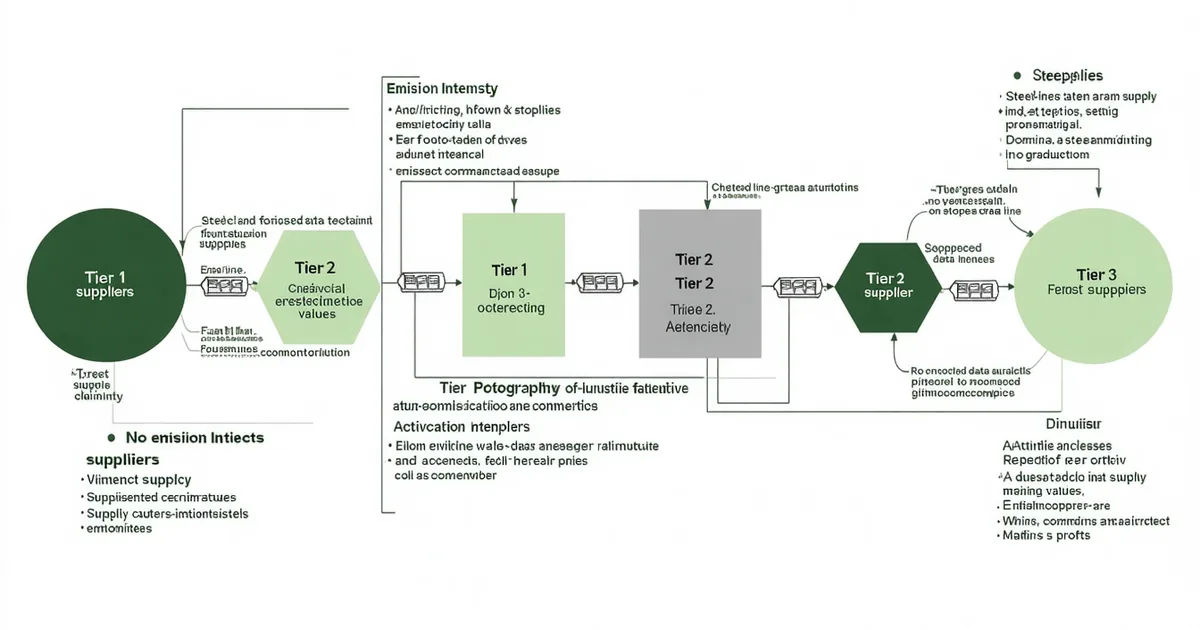
A Tier 1 automotive supplier — say, a seating systems manufacturer supplying directly to assembly plants — faces a specific Scope 3 challenge: their most material Category 1 (purchased goods) emissions come from Tier 2 and Tier 3 suppliers who have varying degrees of emissions accounting maturity.
A Tier 2 steel stamper supplying brackets to a Tier 1 seating supplier may have basic utility data for Scope 2 but no meaningful Scope 3 tracking. Their product-level emissions intensity is typically estimated using spend-based or physical quantity-based methods, not supplier-specific data. Under GHG Protocol Scope 3, this is acceptable — spend-based and physical intensity methods are both recognized approaches — but it creates disclosure requirements around methodology and uncertainty that many mid-size manufacturers underestimate.
In practice, what we see in Detroit-area supply chains: Tier 1 suppliers facing direct OEM pressure on emissions disclosure, doing reasonable Scope 1 and 2 tracking, but relying heavily on industry average emission factors for Category 1 purchased goods because their Tier 2 supplier base hasn't started tracking. The Category 1 estimates are often the largest single line item in a manufacturer's Scope 3 inventory, and they carry the highest methodological uncertainty.
Natural gas intensity in stamping and heat treating
Stamping operations, heat treating, painting lines, and welding are among the more energy-intensive manufacturing processes in the automotive supply chain, and natural gas is often the primary energy source for process heat. Scope 1 from natural gas combustion is typically the largest single emissions source for these operations.
The accounting challenge isn't the calculation — natural gas combustion factors from EPA and IPCC are well-established. The challenge is meter attribution. A facility running multiple stamping lines, a paint booth, and a heat treat oven on a single gas main may not have submeter data to attribute consumption to processes. That matters when you're trying to build a product-level carbon footprint for a specific part number, which OEMs increasingly request.
We've worked through this attribution problem with manufacturers who have single-point metering and need to produce part-level footprints. The approaches are either process engineering estimation (energy consumption per press cycle multiplied by cycle count per part) or statistical regression from production records. Neither is as clean as direct submeter data, and both require methodology disclosure. But they're defensible under GHG Protocol if documented properly.
Freight density and Category 4 / Category 9 complexity
Detroit-area manufacturers tend to run freight-intensive operations. Just-in-time delivery to assembly plants means multiple deliveries per week, often per day. Inbound materials — coils, castings, resins, sub-assemblies from regional suppliers — arrive on tight schedules. The upstream (Category 4) and downstream (Category 9) transportation footprints are proportionally larger than for manufacturers with more centralized, less frequent logistics.
Calculating Category 4 requires either carrier-provided fuel efficiency data or distance-based activity data combined with an industry-average fuel efficiency assumption. For the large carriers (Penske, Ryder, major LTL networks), this data is increasingly available through carrier sustainability portals. For smaller regional carriers — which are common in Detroit-area automotive logistics — you're typically working with assumed fuel efficiency factors from EPA MOVES or FHWA freight emission factor tables.
A specific scenario we've modeled: a mid-size seating component manufacturer in Romulus, Michigan running approximately 180 inbound shipments per month from suppliers in Michigan, Ohio, and Indiana. Using carrier distance data and average LTL fuel efficiency assumptions, Category 4 runs roughly 400-600 tCO2e annually — material enough to matter in their Scope 3 total, but frequently estimated from incomplete carrier data with methodology gaps.
EV transition complicates historical base years
The shift toward electric vehicle platforms is creating a specific carbon accounting wrinkle for Detroit-area parts manufacturers: the products they make are changing in emissions relevance. A manufacturer supplying drivetrain components to ICE vehicles has Category 11 (use of sold products) as a major Scope 3 item — the fuel combustion during vehicle lifetime use is attributed upstream to suppliers under GHG Protocol's approach. Suppliers to ICE drivetrains carry significant Category 11 emissions.
As suppliers shift toward EV platforms — battery enclosures, thermal management components, structural parts for EV architectures — their Category 11 picture changes significantly. The electricity consumed by an EV during its lifetime is typically attributed to the vehicle manufacturer (OEM) under their Scope 3 accounting, not to Tier 1 component suppliers. So a supplier transitioning from ICE to EV programs may see Category 11 shrink substantially in their inventory.
This creates base year restatement questions. GHG Protocol's guidance allows for base year recalculation when structural changes make the original base year no longer representative. Tracking which products are ICE-relevant versus EV-relevant, and how that mix is shifting, is a category of data management most manufacturers haven't structured yet.
What's actually tractable versus what needs tolerance for estimation
We're not saying every emissions category is solvable to high precision for Detroit-area manufacturers. Some things are tractable with current data:
- Scope 1 natural gas and fuel combustion — meters exist, utility invoices are structured
- Scope 2 electricity — utility invoices, eGRID subregion factors, REC documentation
- Category 4 / Category 9 freight for major carriers — increasingly available from carrier portals
- Scope 3 Category 3 (energy-related activities) — follows directly from Scope 1 and 2 data
Some things require estimation with disclosed methodology:
- Category 1 purchased goods from Tier 2+ suppliers without emissions data — spend-based or physical quantity methods
- Category 11 use of sold products — requires product energy consumption modeling
- Freight from small regional carriers — industry average fuel efficiency factors
A defensible CSRD or GHG Protocol inventory doesn't require that every category be primary-data measured. It requires that estimation methods be documented, uncertainty disclosed, and the approach consistent year-over-year. The trap is treating "we can't get exact data" as meaning "we can't account for it at all." The GHG Protocol is explicit that estimation under documented methodology is required, not optional, when primary data isn't available.
That's the standard we built Circulyft around: structured methodology documentation for every emission source, whether the underlying data is precise or estimated.