When manufacturers install material tracking infrastructure for EPR compliance — scale-bridge integrations, container tagging, chain-of-custody logging — they're building something more than a regulatory documentation system. They're building a continuous measurement layer on their production floor that captures data no existing system was collecting. The compliance benefit is the business justification. The operational analytics are the ongoing return.
This is about what that data actually shows, and why production managers and plant operations directors have a separate reason to care about material flow tracking beyond the sustainability team's regulatory obligations.
The Data Gap That Compliance Infrastructure Closes
Most discrete manufacturing facilities have reasonably good production data: parts per hour, cycle time, first-pass yield, OEE. What they don't have, in most cases, is granular scrap yield data at the container level — how many kilograms of scrap a specific line generates per shift, per production order, per material lot, broken down by material grade and disposition.
This gap exists because scrap was always a cost center, not a performance metric. It went out the gate on a recycler pickup, showed up as a line item in materials accounting, and that was the end of the story. Nobody needed kilogram-level resolution because nobody was doing anything with it.
EPR compliance changes that. When you need to document scrap generation by material grade per facility per quarter, you build the measurement infrastructure to get that data. And once that infrastructure exists, the data it produces — continuous, line-level, shift-level — starts answering questions that plant managers have wanted to answer for years.
Scrap Yield Variance: What the Numbers Actually Show
Scrap yield variance is the difference in scrap generation rate between production lines, shifts, or time periods running the same program on the same material. In theory, if two lines are running the same tooling on the same steel coil stock, their trim scrap generation should be nearly identical. In practice, there's almost always variance — and that variance has a cause.
In a Midwest metal stamping operation running a high-volume bracket program on two parallel press lines, continuous scale capture revealed a persistent 11% difference in steel scrap per part between Line 3 and Line 7 over a 12-week period. Both lines ran the same die, same program parameters, same incoming coil width. The variance traced to die timing — Line 7's die maintenance had allowed a blank holder pressure drift that was generating slightly larger trim offcuts per cycle. The die had been running at this state for several months; the variance had been invisible because scrap weight data wasn't collected at line resolution before the material tracking system was deployed.
That 11% variance on a 4,000-parts-per-day line running 1.8 kg of steel input per part translated to approximately 80 kg of excess scrap per day — roughly $100/day at prevailing steel scrap prices. Annualized, that's around $35,000/year in unnecessary material loss from a single maintenance condition that would not have been visible without line-level scrap yield data.
Grade Separation and Recycler Value Recovery
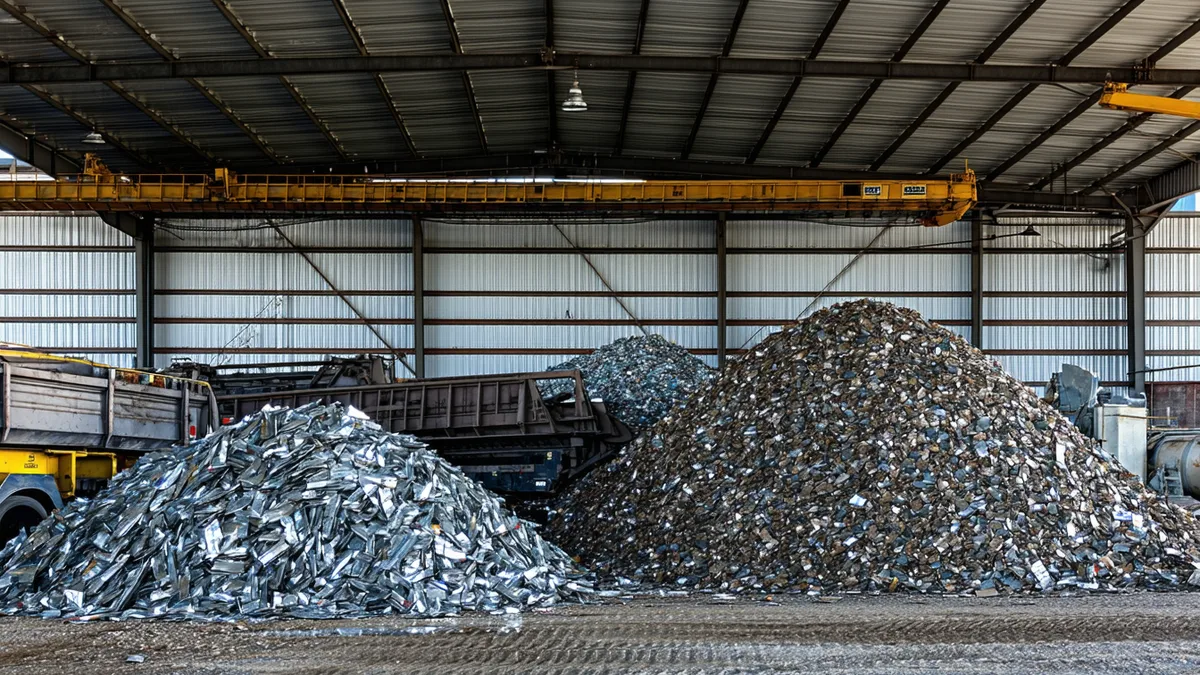
Mixed-grade scrap containers are a reality in most stamping and fabrication operations. Steel grades mix in the trim bin. Aluminum alloy series mix in the scrap bin when multiple jobs run on the same floor area. The recycler takes the container as mixed-grade, pays at the lower grade's price, and that's the economic outcome.
When material tracking systems capture what material was loaded into each container (via line ID and production order association), the data shows how much high-value scrap is being diluted by lower-value mixed loads. For an operation with significant volumes of 6000-series aluminum scrap (which commands meaningfully higher recycler prices than cast alloy mix), grade separation data can identify which lines and which shifts are generating mixed containers versus clean mono-grade batches.
In facilities that have addressed grade separation based on this data, the economic impact is typically in the range of 8-15% improvement in blended recycler revenue per kilogram, depending on the grade spread in the specific material mix. The improvement comes from two sources: capturing higher-grade material at the clean mono-grade price, and reducing contamination that triggers recycler quality adjustments. Neither of these improvements is possible without the container-level grade attribution that material tracking infrastructure provides.
Shift-Level Scrap Patterns and Production Management
Scrap generation patterns vary by shift in ways that are operationally significant but historically invisible. Startup scrap — material consumed during die warm-up, setup, and initial run confirmation — is a normal part of any stamping or injection molding operation. What isn't always visible is how much startup scrap different shifts generate and how quickly each shift reaches stable production yield.
When scale-capture data is available at the shift level, production managers can see startup scrap curves: how many kilograms of scrap the first hour of each shift generates before yield stabilizes, and how that pattern varies between shift teams. A shift that consistently shows 20% higher startup scrap than the adjacent shift on the same line isn't necessarily doing anything wrong — but the pattern warrants examination. It might reflect setup practice differences, die-conditioning discipline differences, or incoming material handling differences. The data surfaces the question; the investigation finds the answer.
We're not saying shift-level scrap data should be used to rank teams or create performance pressure around a secondary metric. We're saying it's operational information that process engineers and production managers can use to understand process stability and identify improvement opportunities — information that no other data source in the facility currently provides at this resolution.
Material Recovery Rate as a Process Quality Metric
In most manufacturing operations, scrap rate is tracked as a quality metric — parts rejected as a percentage of parts attempted. Material recovery rate is a related but distinct metric: what fraction of input material became saleable product versus what fraction left as scrap. These numbers move together but not identically, and the difference is informative.
A stamping line with a 2% parts rejection rate might have a material utilization rate of 78% — meaning 22% of input steel left as trim scrap regardless of part quality. A different line configuration, nesting optimization, or blank size might improve material utilization to 81%, reducing trim scrap generation by 13% without changing the parts rejection rate at all. Material utilization optimization is a separate discipline from quality improvement, and it requires material-level scrap data — specifically, the weight-based picture of what goes in versus what comes out in saleable form versus what leaves as scrap — to drive it.
EPR compliance tracking builds this data set as a byproduct. The material flow documentation that satisfies a state EPR filing — input material consumption, scrap generation by line and grade, recycler recovery — is the same data set that enables material utilization analysis. The compliance infrastructure is the platform; the operational analytics are available to any production function that knows how to use them.
Making the Data Actionable
The value of material flow analytics data depends on whether it reaches the people who can act on it. Sustainability teams use it for EPR filings and GRI disclosures. Production managers use it for process improvement. Materials management uses it for scrap grade separation and recycler contract optimization. These are different users with different analytical needs, and a material tracking system that only serves the sustainability team leaves most of the operational value uncollected.
The practical requirement: material flow data needs to be visible to production supervisors and plant managers in a format they can act on — shift-level yield summaries, line comparisons, grade breakdowns — not just accessible to sustainability analysts who export it for quarterly reporting. When production supervision can see the scrap yield data for their shift in the same view where they see throughput and quality metrics, the data becomes a production tool rather than a compliance artifact. That's when the operational ROI compounds.