The economics of EPR compliance are primarily a documentation labor problem. Most of the time manufacturers spend on compliance preparation isn't analytical — it's assembly. Pulling records from MES. Chasing recycler certificates from email inboxes. Reconciling hauler invoices against scale records. Trying to connect a recycler pickup confirmation to the specific container generation event it corresponds to.
Scale-bridge integration doesn't solve every EPR compliance challenge, but it eliminates the largest single source of manual labor in material tracking — and with it, the largest single source of error that makes filings indefensible.
What a Scale-Bridge Integration Actually Does
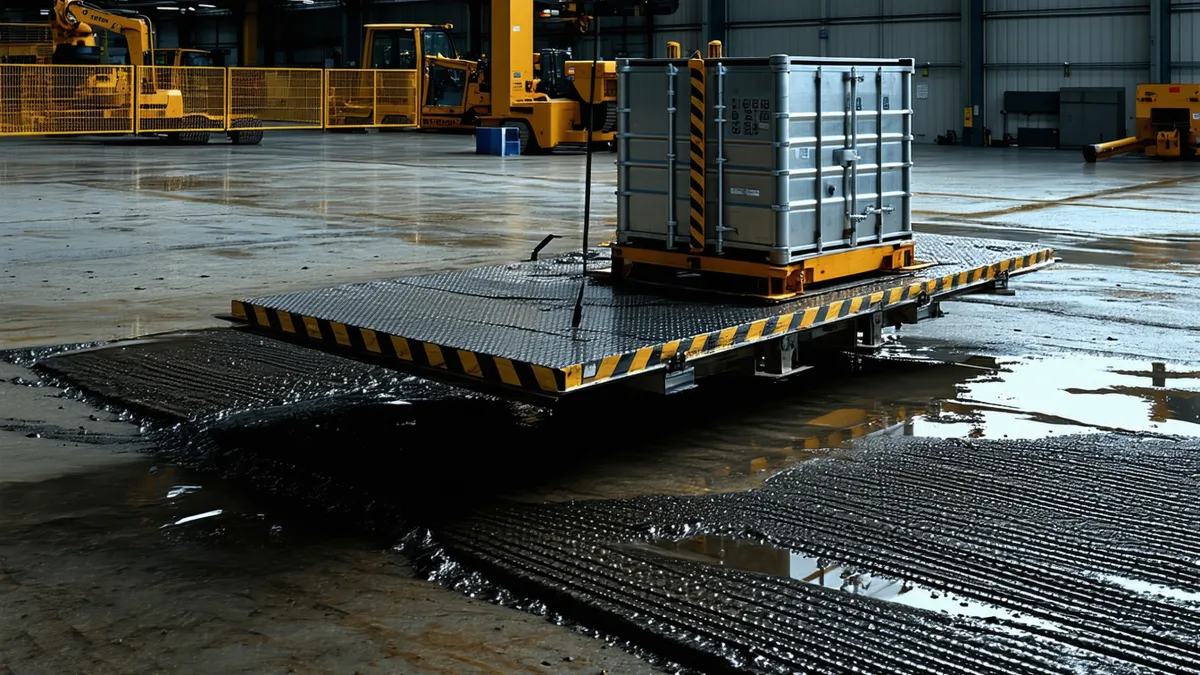
A scale-bridge integration connects your industrial weighing equipment — floor scales, container scales, in-floor weigh systems, or loading dock scales — directly to your material tracking software. When a scrap container is placed on the scale, the weight is captured electronically and associated with a container identifier (from a QR scan, RFID read, or manual entry). That weight record flows into the material tracking system without any manual transcription.
The integration typically operates via Modbus TCP, RS-232 serial, or Modbus RTU protocols, depending on the scale's communication interface. Modern industrial scales from manufacturers like Mettler-Toledo (IND780, IND570), Rice Lake Weighing Systems, or Avery Weigh-Tronix support at least one of these protocols as standard. The integration side is a reading of the scale's output register — it doesn't modify the scale's operation or require changes to its calibration configuration.
From the material tracking perspective, the integration delivers: a weight figure that is directly measured (not operator-entered), a timestamp that is system-generated (not subject to after-the-fact logging), and a container association that is scan-confirmed (not handwritten). These three attributes — measured, timestamped, scan-confirmed — are the difference between a weight record that survives audit scrutiny and one that doesn't.
The Error Economics of Manual Entry
In facilities without scale-bridge integration, operators log scrap weights manually — at end of shift, at container fill, or when a recycler pickup is scheduled. The error patterns in manual weight logging are well-documented in industrial operations literature: transcription errors in the 2-5% range, systematic rounding (operators log to the nearest 50 kg rather than actual readout), timing errors (weights recorded hours after actual measurement), and outright missing entries when production pressure overrides logging discipline.
For EPR compliance, these errors compound. If your generation records systematically over-report weights (rounded-up logging) and your recycler certificates show lower received weights, your closed-loop percentage calculated from generation records will be lower than the certificates support. If your generation records under-report weights (systematic rounding down), your denominator is understated and your closed-loop percentage looks better than it should. Either direction, an auditor sees a discrepancy between your internal records and your recycler documentation — and that discrepancy requires explanation.
In a 250-person stamping facility running two shifts generating approximately 25 metric tons of scrap per week, even a 3% systematic logging error represents 750 kg per week — nearly 40 metric tons per year — of documentation variance. That's not a rounding issue. That's an audit flag.
What Changes When the Scale Talks Directly
When scale-bridge integration is in place, the compliance workflow changes structurally. Generation events are captured automatically at the moment of weighing. Container identifiers associate material grade, source line, and timestamp with each weight record without operator intervention. The recycler pickup event is logged when the driver scans the container, capturing departure weight from the same scale that captured fill weight.
The reconciliation step — comparing generation weight to recycler received weight — becomes a system-automated comparison rather than a manual audit exercise. Discrepancies beyond a defined threshold (typically 3-5% to allow for moisture variation and handling loss) generate an alert. Within-threshold matches generate an automatic confirmation record that becomes part of the chain-of-custody documentation for that container batch.
For EPR filing, this means the evidence package for each material batch is assembled from system records, not from assembled documentation. The generation weight, the container ID, the pickup timestamp, the carrier confirmation, and the recycler certificate match can all be exported as a structured record. The time to generate an EPR filing drops from days of assembly work to hours of review and sign-off.
Integration Complexity: What to Expect
We're not saying scale-bridge integration is trivial. Facilities vary significantly in scale equipment age, communication protocol support, and network infrastructure. A facility running 15-year-old floor scales on RS-232 serial interfaces in an environment with no plant-floor network is a different integration project than one with modern TCP/IP-enabled scales on an existing industrial LAN.
For most discrete manufacturing facilities, however, scale integration is a 1-to-3-week technical project, not a months-long infrastructure overhaul. Common requirements: a network path from the scale to the plant network (often a simple serial-to-Ethernet converter for legacy scales), a container identification method at the scale station (QR scanner, barcode reader, or manual container ID entry), and configuration of the tracking software to receive and log the scale output.
The most common integration barrier isn't technical — it's organizational. Scale calibration and maintenance are owned by the quality department. Plant network access is controlled by IT. Container identification processes are set by production supervision. Getting the three groups aligned on a scale-bridge integration project requires a coordination step that materials management or sustainability rarely drives. Identifying that coordination dependency early — ideally during a compliance infrastructure audit — is the difference between a project that gets done and one that stalls at the "we're going to look into it" stage.
The ROI Beyond Compliance
EPR compliance is the forcing function that gets scale-bridge integration funded. But the operational data generated has value independent of regulatory requirements.
When you have continuous, automated scale data for every scrap container by source line, you have real-time scrap yield by line — data that production engineers have historically only been able to estimate. A line generating 15% more scrap per part than the line running the same program next to it is a process variance that costs real material, and that variance is invisible without container-level weight attribution. Scale-bridge integration makes it visible.
For a facility running aluminum stampings at a material cost of $2.50/kg, a 1% improvement in scrap yield rate on a 20,000 kg/week production volume is $500/week, $26,000/year. That's a separate business case from EPR compliance, and it's available to any plant that deploys scale-capture infrastructure for compliance reasons. The compliance benefit is the justification for the investment. The yield data is the ongoing return that makes the investment compounding.