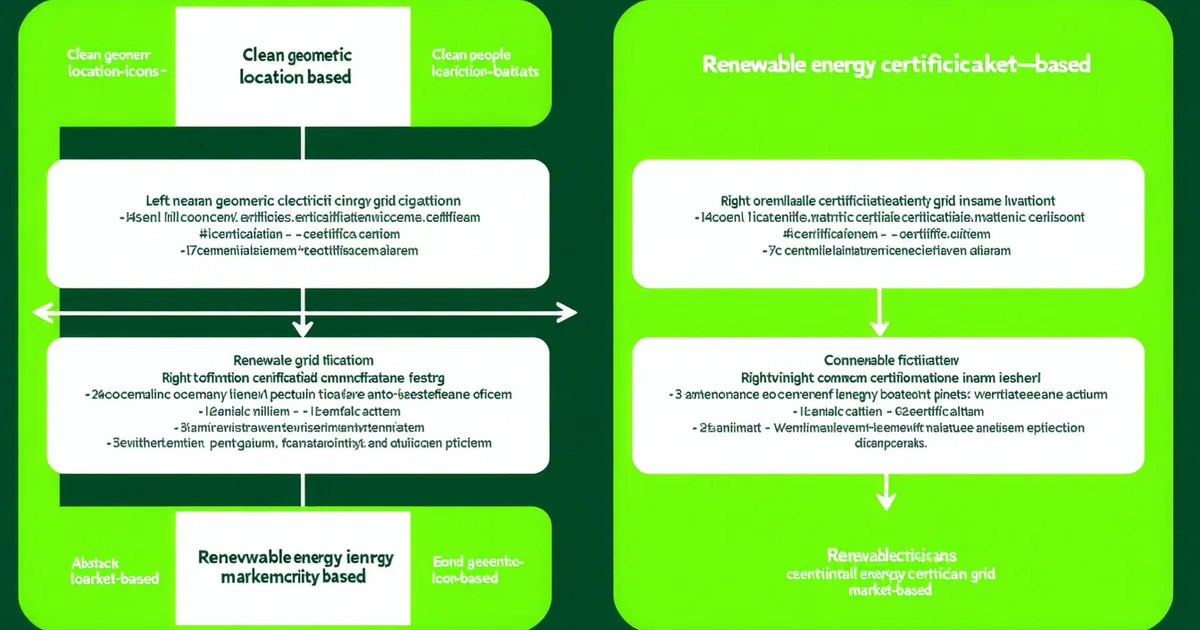
The GHG Protocol's Scope 2 Guidance introduced the dual-reporting requirement in 2015: companies must disclose both a location-based and a market-based Scope 2 figure. CSRD's ESRS E1 reinforces this — both calculations are required in your disclosure. Nearly a decade on, we still see sustainability managers treating this as an optional detail or conflating the two methods in ways that produce technically incorrect disclosures.
This post explains what each method actually measures, when the numbers diverge significantly and why, and the specific data you need from your utility and energy procurement records to calculate both correctly.
What location-based Scope 2 measures
Location-based Scope 2 reflects the average emission intensity of the electricity grid in the geographic area where your consumption occurs. You take the kWh consumed at each facility, multiply by the relevant grid average emission factor for that subregion or country, and sum across facilities.
For US facilities, the EPA's eGRID database provides subregion-level emission factors updated annually. The MROE subregion (Midwest Reliability Organization East, which covers much of Michigan and neighboring states) had a 2022 grid average of approximately 0.4236 lb CO2e/kWh — significantly higher than coastal grids because of the generation mix in the region.
Location-based is a physical reality check: regardless of what contracts you've signed, this is the actual carbon intensity of the electrons flowing into your facility based on what's on the grid near you.
What market-based Scope 2 measures
Market-based Scope 2 reflects the emission intensity of electricity based on contractual instruments — specifically instruments that transfer the environmental attributes of electricity generation to a buyer. The instruments that qualify under GHG Protocol's Scope 2 Guidance are:
- Supplier-specific emission rates — if your electricity supplier provides a disclosed residual mix emission factor or a certified product emission factor, you can use that instead of the grid average
- Energy Attribute Certificates (EACs) — in the US, these are Renewable Energy Certificates (RECs); in the EU, Guarantees of Origin (GOs). When you hold RECs or GOs covering your consumption, you report zero market-based emissions for that portion of consumption
- Power Purchase Agreements (PPAs) — if you have a PPA with a renewable generator, the PPA typically includes the associated RECs and you can claim zero market-based emissions for contracted volumes
If none of these instruments apply — if you simply buy electricity from the grid without any qualifying contractual instrument — then you use the residual mix emission factor for your market. In the US, this often means using a state-level residual mix factor where available, or defaulting to the eGRID subregion rate, which in practice produces results close to the location-based figure.
Why the two numbers can diverge sharply
The gap between location-based and market-based becomes meaningful when a company has purchased RECs or signed PPAs. Consider a manufacturer with 18 GWh annual electricity consumption split across four Michigan facilities. Their location-based Scope 2, calculated at the MROE grid average, might be approximately 3,400 tCO2e.
If that manufacturer purchased 18,000 MWh of RECs from a wind farm in Michigan — which they hold in a tracking system like M-RETS and retired against their 2024 consumption — their market-based Scope 2 would be reported as zero, or near-zero if using a residual mix factor for consumption not covered by the RECs.
That's a 3,400 tCO2e difference between the two figures for the same physical energy consumption. Both numbers are correct under GHG Protocol. Both are required in CSRD disclosure. They answer different questions: location-based answers "what did the grid emit to serve you?" and market-based answers "what have you contractually taken responsibility for?"
The REC quality problem
Not all market-based instruments are treated equally by auditors and sophisticated buyers. GHG Protocol's Scope 2 Guidance establishes a quality hierarchy based on attributes of the EAC:
- Temporal matching — ideally, EACs cover the same time period as consumption (monthly or hourly matching is better than annual)
- Geographic proximity — EACs from the same grid region as consumption are more credible than cross-market RECs
- Additionality — RECs from recently commissioned renewable projects (within 10 years) carry more weight than RECs from long-depreciated hydro projects
Annual, unbundled RECs from out-of-state hydro projects — which are widely available and cheap — satisfy the technical requirement for market-based reporting but are increasingly scrutinized by investors and corporate buyers who know the methodology. We're not saying using such RECs is wrong; we're saying that if you're reporting market-based Scope 2 of zero based on them, that methodology choice needs to be disclosed explicitly, and some stakeholders will view it skeptically.
What data you actually need
For location-based Scope 2, you need monthly kWh consumption by facility and the applicable eGRID subregion for each facility's ZIP code. The EPA's eGRID lookup tool maps any US ZIP code to its subregion. If facilities are outside the US, you need country-level or regional grid emission factors from the relevant national inventory.
For market-based Scope 2, you need:
- Any supplier-specific emission rate disclosed on your electricity invoice (many utilities don't provide these; if absent, you use residual mix or grid average)
- REC or GO certificate documentation: certificate ID, generating facility, generation date, generation technology, registry (MRETS, WREGIS, NAR for US markets)
- The residual mix emission factor for your market if you have unconceived consumption — most US state associations don't publish residual mix factors, so companies often fall back to eGRID subregion rates, which is technically acceptable but should be documented as an assumption
Common errors in dual reporting
The error we encounter most often is using eGRID factors for both calculations and calling one "location-based" and the other "market-based" without any market instruments applying. If you don't have qualifying market instruments, your market-based figure will equal your location-based figure — which is a valid and common outcome for manufacturers without active renewable energy procurement. The error is labeling undifferentiated figures as dual-method calculations.
A related error is applying RECs to market-based without verifying that the RECs were retired in your name within the relevant tracking registry for the reporting year. RECs that were purchased but not formally retired don't transfer environmental attributes under GHG Protocol rules.
Finally, watch for partial coverage: if your RECs cover only 60% of your annual kWh consumption, you apply zero to the covered 60% and the residual mix factor to the remaining 40%. We see reports where companies apply zero to 100% of consumption when they've only partially covered their load.
Reporting both numbers clearly
ESRS E1 requires disclosure of both location-based and market-based Scope 2 separately, along with the methodology and data sources used. The disclosure should note: which eGRID version was used, what qualifying contractual instruments were held and in what volumes, and whether any facilities used supplier-specific rates versus grid averages.
When Circulyft processes utility invoice data, we maintain both calculations in parallel for every facility — the location-based figure from the eGRID factor mapped to each facility's ZIP code, and the market-based figure adjusted by any REC retirements or PPA volumes that the user has entered. The two figures are stored separately, linked to their respective source documents, and flow into the ESRS E1 output table in the format auditors expect.
Running both methods isn't overhead — it's the complete picture. Location-based shows your physical footprint on the grid. Market-based shows what you've done about it. Your CSRD disclosure needs both, and your auditor will verify both.